至誠
Sincerity
Do the real thing, not the appearance of it.
Our namesake
Ninomiya Kinjiro had no school and no teacher. He is the reason this software exists.
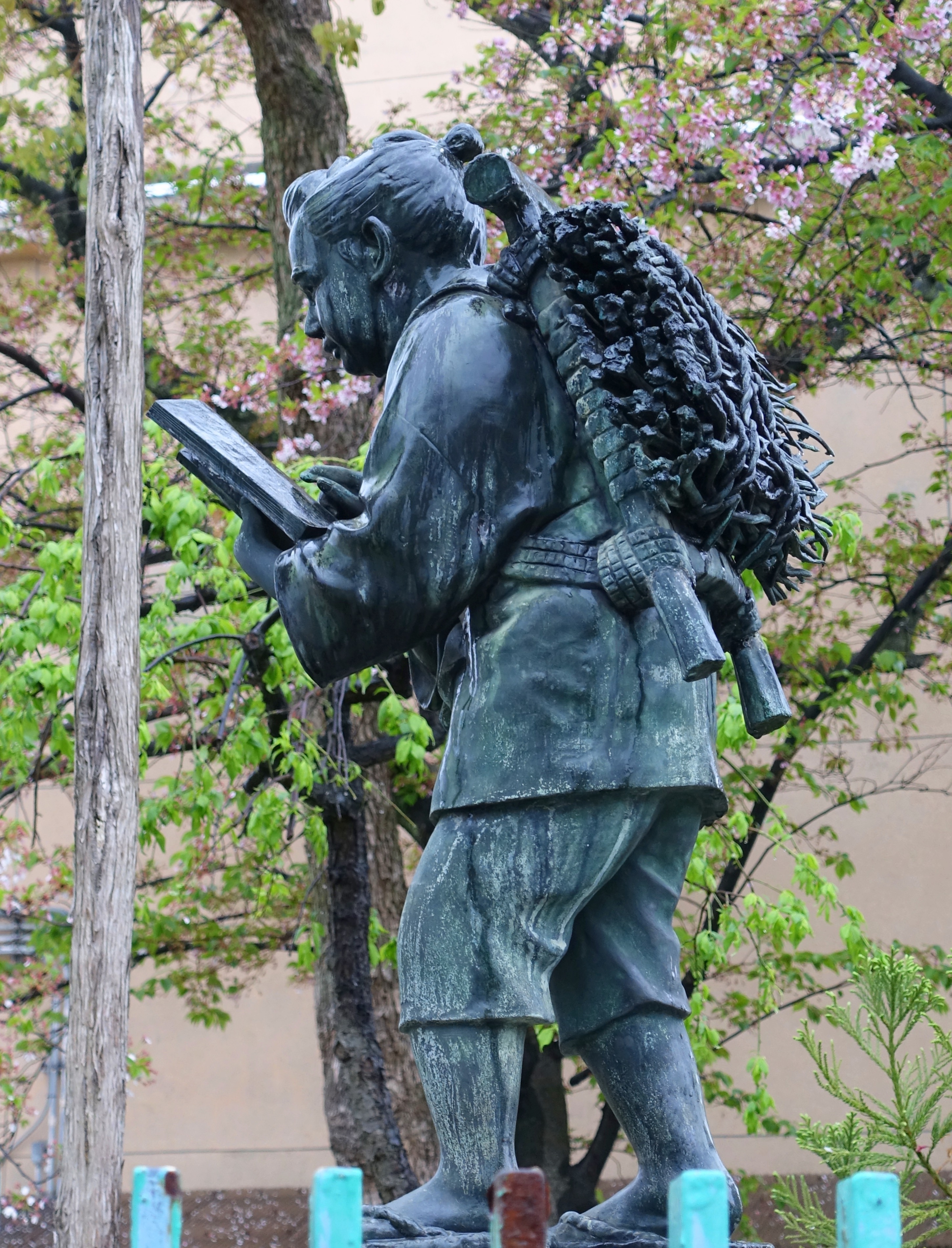
Ninomiya Kinjiro was born to a farming family in Odawara, Japan, in 1787. Floods took his family's land. Both his parents died before he was sixteen. He was sent to work in a relative's house, with no school, no teacher, and no reason to expect that a boy in his position would ever be educated.
So he educated himself. He read whenever his hands were free — famously, walking the hills with a load of firewood roped to his back and a book open in front of him.
He never stopped. Not when he was a labourer, not when he was a landowner, and not when he had become the most sought-after reformer in Japan. He read, studied the land, tested what he learned, and revised what he believed, for sixty-nine years.
He rebuilt more than six hundred villages that had collapsed into debt and hunger — not by sending them money, but by teaching families how to restore their own households. He worked out how much a village actually produced, how much it actually needed, and how the surplus could be set aside instead of spent. Then he taught them to run it themselves.
A century later his statue stood in nearly every elementary school in Japan: the boy with the firewood and the book.
His influence outlived him by generations. Toyoda Sakichi, who founded what became Toyota, and Matsushita Konosuke, who founded Panasonic, both named his teaching as formative. So did Shibusawa Eiichi, the man remembered as the father of Japanese capitalism. None of them ever met him — he died in 1856. They simply read what he taught and built on it, which is rather the point.
積小為大
sekisho idai — "Small things accumulated become great."
His central maxim. He rebuilt villages the same way he educated himself: through modest, honest, repeated effort that compounds. No single dramatic act. Just the next right thing, done again tomorrow.
His system rested on four ideas he called Hotoku:
至誠
Do the real thing, not the appearance of it.
勤労
Work is not the interruption to a good life; it is part of one.
分度
Know what you actually have.
推譲
Set something aside for others and for the future.
Because he believed a person should be learning their whole life — and he proved it by doing it himself, from nothing, until the day he died.
He had no school, no teacher and no permission, and none of that stopped him. He also never treated his education as a thing he had finished. There was no point where he had arrived, no certificate that closed the subject. Learning was simply how he lived, and it stayed that way for sixty-nine years.
That's what we're actually building for. Not a way to reproduce school at the kitchen table, but support for families who have decided that education is something their children own — that it happens inside ordinary days, in the work and the walking and the reading, and that it doesn't stop at eighteen because it was never bounded to begin with.
Kinjiro is the proof that this works. He is also the reminder that it takes a very long time, and is made of very small pieces.
We build for the parent who has taken this on themselves. Our job is to hold the record so you can pay attention to the child.
Because sekisho idai is the honest description of raising someone. The page read on a tired Tuesday. The argument worked through. The skill that took four months. The chore finally done without being asked. None of it looks like much on the day.
Accumulated, it becomes a person — curious, capable, decent, and hard to discourage. Someone who can run a household, think for themselves, and leave the places they pass through better than they found them. A whole human being, sent into the world able to do some good in it.